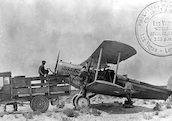


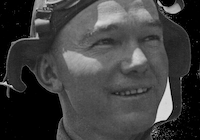
Col. John Arthur Macready has been selected for his high altitude and endurance flight records. In 1903, Orville Wright flew for 12 seconds, covering a distance of 120 feet. By 1908, Wilber Wright was able to complete a flight that lasted 2 hours and 20 minutes. Glenn Curtiss won the first international speed event, completing a 10 km course averaging 46.5 miles per hour. All of the aircraft involved were pusher biplanes (two-winged with a single engine behind the pilot). World War I greatly accelerated aircraft development. Tractor biplanes (two-winged with one or more engines facing the front of the plane) replaced the pusher planes. Both the Allies and Central Powers used military aircraft offensively, defensively and for reconnaissance purposes. Aircraft continued to evolve from low powered biplanes made of wood and fabric into high powered aluminum monoplanes. Postwar, air races and their prize money led to the rapid evolution of engines and airframes. The military also saw the need to fly faster, higher and longer in order to establish and maintain air superiority. Thus began one of the most exciting periods in aviation history. John A. Macready was born October 14, 1887, in San Diego. When he was very young, his father went to Searchlight, NV to prospect for gold. Through a combination of good luck and clever negotiations, John's father struck it rich and formed the Quartette Mining District. When John was twelve years old, his father began sending him to work in the mines each summer. In 1907, John entered Stanford University but worked in the mines every summer to earn spending money for the school year. He graduated in 1912 with a degree in economics, returned to Searchlight for what was to be a short visit, and stayed for four years. In 1913, the residents of Searchlight elected him Justice of the Peace, a position that paid poorly, so he continued to work in the mines when his duties allowed. By 1916, he had become a successful business man in his own right and was a member of the Clark County Republican Central Committee. On April 6, 1917, the United States declared war on Germany, entering WW I. A month later, an Army recruiter passed through Searchlight and John enlisted. Basic flight training was provided by the School of Military Aeronautics at the University of California, Berkeley. He was then transferred to Rockwell Field in San Diego where he received his wings and commission as a second lieutenant. John was assigned to the Army Pilot School at Brooks Field, TX, where he served as officer in charge of flying. While there, he wrote "The All Through System of Flying Instructions as Taught at Brooks Field." This document became the basic training manual for the U.S. military aviation program. After the war, he was assigned to the Air Service Experimental Test Center at McCook Field, OH. While there, he became an engineering test pilot, working on the turbo supercharger development program. For the next six years he flew all program test flights, climbing higher and higher with each flight. In 1921, John received his first of three MacKay Trophies for his high altitude test flights as well as for shattering the world's altitude record, attaining a height of 40,800 feet in an open cockpit. John spent most of this 1 hour 47 minute flight reaching the new altitude. At 39,000 feet, ice formed on the oxygen tank causing it to fail. John then needed to switch to auxiliary tanks to continue flying. When the engine died at 40,800 feet, he glided back to earth. In 1922, John and Lt. Oakley Kelley received the MacKay Trophy (John's second) for their flight endurance record of 35 hours, 18 minutes. Then, in 1923, Macready and Oakley took off from Roosevelt Field on Long Island in a modified Fokker T-2 aircraft in an attempt to fly coast-to-coast. Macready landed the plane in San Diego 26 hours 50 minutes and 38 3/5 seconds later, having flown a total distance of 2,520 miles. Both men were awarded the 1923 MacKay trophy for this flight. Later in 1923, John and Capt. A. W. Stevens completed the first aerial photographic expedition across the U.S. They took 1,700 pictures documenting scenic America as well as reclamation projects in arid regions of the country. John resigned from the Air Service in 1926 but continued to participate in exhibition and racing events. He became the aviation manager for Shell Oil in 1929 and continued in this capacity until he retired in 1933. With the outbreak of WW II, John was called back to service to command several Army Air Force units and served in North Africa with the 12th Air Force. He retired from active duty as a Colonel in 1948 and died at his home near Mariposa, CA on September 15, 1979.